Here is something most people do not know: two identical AC units installed in the same size home can perform very differently. The system that runs better, costs less to operate, and lasts longer is almost always the one that was installed correctly.
The equipment matters, but the installation matters just as much. A sloppy install can rob your system of efficiency, shorten its life, and void your warranty, all without you ever knowing something went wrong.
If you are getting a new AC unit installed in your Louisiana home, this guide will walk you through every step of the process. By the end, you will know exactly what a professional installation looks like and what questions to ask when you hire a company.
Why the Installation Process Matters So Much
A lot of homeowners focus entirely on which AC brand or model to buy. That makes sense. But here is the part that often gets skipped: a poorly installed system will never perform the way it should, no matter how good the equipment is.
Bad installations lead to higher energy bills, uneven cooling, more repairs, and shorter system life. In a state like Louisiana where you rely on your AC for six to eight months out of the year, that is a very expensive problem.
The good news is that knowing what a proper installation looks like helps you make sure you are getting one.
Step 1: The In-Home Estimate and Pre-Installation Planning
Before a single tool comes out, a trained comfort specialist should visit your home to assess the job. This visit is not just a sales call. It is a necessary step in making sure your new system is set up for success.
During this visit, the technician will take measurements, look at your existing equipment, check your ductwork, and note anything that might affect the installation. They will also determine whether your current system’s location will work for the new one.
Here is something that surprises many homeowners: modern AC units are physically bigger than units made 10 to 20 years ago. The larger coil size is what makes them more efficient. But it also means the old spot may not work anymore. Sometimes the outdoor unit needs to be moved, which adds to the job but is often necessary.
The Manual J Load Calculation
One of the most important things that should happen at this visit is a Manual J Load Calculation. This is how a technician figures out the right size AC for your home.
This calculation looks at things like your home’s square footage, ceiling height, number of windows and doors, insulation levels, and how much sun your home gets. All of these affect how much cooling your home needs.
An AC that is too small will run nonstop and never fully cool your home. An AC that is too big will turn on and off too quickly, which means it never runs long enough to pull moisture out of the air. In Louisiana, where humidity is a real problem, an oversized system is especially uncomfortable.
Never let a company skip the load calculation. If they just look at your old unit and order the same size, that is a red flag.
Step 2: The Install Team Arrives
On installation day, you should receive a call or text before the team arrives. A professional company will also share the names and photos of the technicians coming to your home, so you know who to expect.
When the lead installer arrives, they will review all the job details with you. This includes the equipment being installed, any accessories, and any special instructions from your estimate. Taking a few minutes to go through this before work begins prevents mistakes and makes sure everyone is on the same page.
While you are doing that review, the rest of the team will get to work laying down floor protection to keep your home clean and gathering their tools and equipment.
Step 3: Powering Down the Old System Safely
Before anything is removed, the team will shut off the electrical circuits and gas supply to your existing HVAC equipment. This is a non-negotiable safety step.
Working on a live system is dangerous, and skipping this step is something no legitimate HVAC company would do. If you ever witness a contractor working on your system without first shutting the power down, stop the job and send them home.
Step 4: Removing the Old Outdoor AC Unit
Your old air conditioner has refrigerant inside it. This refrigerant must be removed carefully before the unit can be taken out.
By law, refrigerant cannot simply be released into the air. The EPA requires that a certified recovery machine and tank be used to safely capture the refrigerant. Every person on the install team who might handle refrigerant must also have their own individual EPA certification. This is a legal requirement, not just a best practice.
Once the refrigerant is out, the electrical wiring is disconnected. Near your outdoor unit, there is a disconnect box, which is a safety shutoff. Reputable HVAC companies replace both the disconnect box and the flexible electrical connection (called a “whip”) when they install a new unit. Using old wiring for a new system is another shortcut you do not want your contractor to take.
Step 5: Preparing the Pad for the New Unit
Once the old unit is removed, the ground where your new unit will sit needs to be prepared. New units are bigger and heavier, so the surface needs to be level and solid.
This is done with a gravel base, which allows for proper leveling and drainage. The new unit then sits on a composite pad. A composite pad is specifically designed for outdoor HVAC use. It absorbs vibration, does not crack, and will last as long as your system.
You might hear someone suggest using a concrete pad instead. Concrete is not the right choice here. It cracks and shifts over time, and once it does, it is very hard to fix without moving the unit. A properly designed composite pad is a better long-term solution.
Step 6: Removing the Old Indoor Coil
Inside your home, above or below your furnace or air handler, sits the evaporator coil. This coil is the indoor half of your air conditioning system. The refrigerant travels from the outdoor unit into this coil, and that is where the actual cooling happens.
The old indoor coil needs to come out before the new one goes in. This can be simple or complicated depending on where your equipment is located. Systems in tight closets or finished basements take longer to access. In some cases, there may be an extra charge if the access is especially difficult.
Because modern coils are more efficient, they are also taller. The sheet metal enclosure (called the plenum) around the coil may need to be adjusted to fit the new one properly.
Step 7: Running New Refrigerant Lines (the Line Set)
The refrigerant lines are two copper pipes that connect your outdoor unit to your indoor coil. The bigger pipe is called the suction line, and the smaller one is called the liquid line. Together they are called the line set.
In almost every case, the old line set should be replaced when you get a new system. Here is why: the oil that moves through the refrigerant lines in older systems is different from the oil in newer systems. If those oils mix, it can damage your new equipment.
The one exception is when the old line set is hidden behind walls, in a ceiling, or buried underground. If it truly cannot be replaced, it must be flushed and pressure tested before the new system is connected.
When the new line set is installed, it should run as straight as possible with as few bends as needed. Every bend in the line adds resistance and reduces efficiency. The line set should be secured every four to six feet, and metal clamps should never be allowed to touch the copper directly, which can cause corrosion over time.
A small low-voltage control wire also runs alongside the line set. This wire carries the signal from your thermostat to the outdoor unit, telling it when to turn on and off.
Step 8: Setting the New Outdoor Condenser
With the pad leveled and the line set in place, the new outdoor unit (called the condenser) gets set on the pad.
Before the unit is connected, the installer should inspect it for any shipping damage. Dents do not always cause problems, but you have the right to know about them and to request a replacement unit if you are not comfortable accepting a damaged one.
The refrigerant lines are then fitted to the service valves on the condenser. These valves are the connection points between the line set and the unit. They also let technicians isolate the refrigerant for future service without losing it all, which saves you money on repairs down the road.
Step 9: Brazing, Leak Testing, and Vacuuming
This is the most technical part of the job, and it is also where many contractors cut corners. Pay attention to this section because it directly affects how well your system works and how long it lasts.
Brazing
Once the lines are fitted, they must be permanently connected using a process called brazing. This is a type of welding that uses oxygen, acetylene, and a silver-based filler rod to create a bond that can handle extreme pressure and temperature changes.
During brazing, dry nitrogen is pumped through the copper lines. This protects the inside of the copper from oxidizing (rusting) from the heat. If a contractor skips the nitrogen, the inside of your lines gets damaged in a way you cannot see, and your system will break down sooner than it should.
The brazing process produces an open flame inside and outside your home. This is exactly why installation should always be handled by a trained and licensed professional.
Pressure Testing
After brazing, the system is pressurized with dry nitrogen and checked for leaks. The system needs to hold pressure for at least 10 minutes. If it does not hold, there is a leak somewhere that must be found and fixed before moving forward.
Vacuuming the System
After the pressure test passes, the entire system is put under a deep vacuum. This process pulls out any air, moisture, and other gases that got into the lines during installation. Moisture and oxygen are enemies of refrigerant systems. If they are not removed, they will react with the refrigerant and oil, form acids, and destroy the system from the inside.
The vacuum process takes at least 30 minutes and sometimes longer depending on the system size. It must reach a reading of 500 microns or lower and hold there. This is also the final leak test. A system that will not hold a vacuum has a leak somewhere.
Once the vacuum holds, refrigerant is released into the system. This is a precise step. Only refrigerant can be used to break the vacuum. If the hoses are disconnected before the refrigerant is released, the vacuum is lost and the whole process has to start over.
This entire sequence of brazing, nitrogen purging, pressure testing, and deep vacuuming is what separates a proper installation from a shortcut job. Many companies skip parts of it. Yours should not.
Step 10: Installing the Filter Dryer
A filter dryer is a small but important component that gets installed in the refrigerant line near the indoor coil. It does two things: it absorbs any remaining moisture in the system, and it filters out any tiny particles that could damage the expansion valve.
Every new system installation should include a new filter dryer. This is a manufacturer requirement and an industry standard. Skipping it is a shortcut that puts your new system at risk.
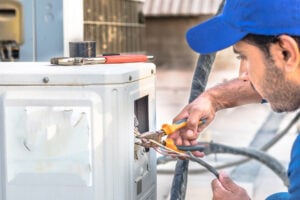
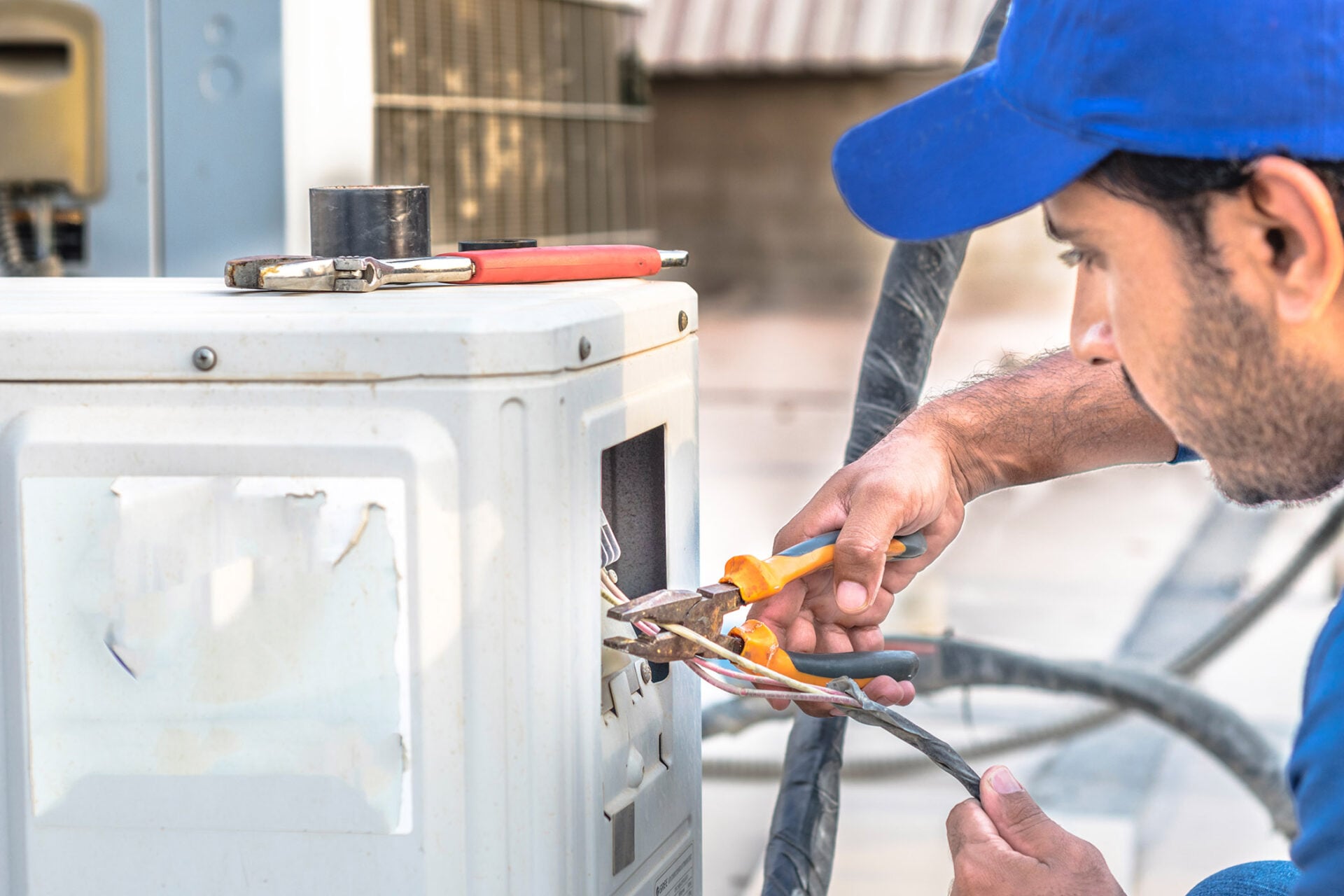
Step 11: Electrical Connections (High and Low Voltage)
With the refrigerant side complete, the electrical connections are made.
A new disconnect box is mounted to the side of your home near the outdoor unit. This box has two purposes: it protects the unit with the right overcurrent protection, and it gives technicians a safe way to cut power to the unit for future service without going back inside to the breaker panel.
There are two types of disconnect boxes: fused and non-fused. The right choice depends on the amperage of your circuit breaker and the requirements of your new unit. Your installer should follow the National Electrical Code (NEC) and the manufacturer’s specifications when making this decision.
The low-voltage control wire (which runs alongside the line set from inside) is connected to the appropriate terminals on the outdoor unit and inside at the furnace’s control board. This is the wiring that lets your thermostat communicate with the whole system.
If your thermostat needs to be updated, this is often handled at this stage as well. Smart thermostats that connect to your phone are a great upgrade that can help you save money on your energy bill every month.
Step 12: Installing the Condensate Drain Line
Every time your AC runs, it pulls moisture out of the air inside your home. That moisture turns into water and needs a place to go.
A PVC drain line runs from your indoor coil to a floor drain, sump pump, or condensate pump. The line must be properly sloped so water flows out on its own.
A few critical things must be done here. First, a trap is installed in the drain line to prevent air from being pulled backward through the drain. Second, an overflow safety switch is installed. If the drain ever gets clogged, this switch shuts the system down before water can spill onto your floor or ceiling. These safety features are required by code and should always be part of a proper installation.
Step 13: Startup and Commissioning
Now comes the moment everyone has been working toward. The system is turned on for the first time.
But “turning it on” is not the end of the job. A proper startup and commissioning process takes 15 to 20 minutes at minimum while the system is running. During that time, the installer collects a full set of data points to confirm the system is working exactly as it should.
Here is a partial list of what your technician should be checking and recording:
- Suction and liquid line pressure and temperature
- Superheat and subcooling readings
- Indoor and outdoor temperature readings
- Return air and supply air temperatures
- Airflow (in CFM)
- Voltage and amperage on all motors
- Static pressure readings
- Amount of refrigerant added (if any)
These readings are compared against the manufacturer’s specifications. If something is off, the technician adjusts it on the spot. This data also serves as a baseline record of how the system should perform, which is useful if any issues come up down the road.
Unfortunately, many HVAC companies skip this step entirely. They turn the unit on, feel cold air coming from the vents, and call it done. That is not a commissioning. A real commissioning takes equipment, training, and time. It is the only way to know for certain that your system was installed correctly.
Step 14: Cleanup and Final Walkthrough
A professional install team leaves your home the way they found it. All old equipment and materials are removed and hauled away. Floor protection is rolled up and taken with them. The work area is swept and left clean.
Before the team leaves, your lead technician should walk you through what was done. They will cover how to use your thermostat, what maintenance your system needs, and what your warranty covers. You should also receive a locking cap for the outdoor unit that prevents tampering and refrigerant theft.
Ask questions at this point. A good company wants you to understand your system and feel confident about your investment.
Red Flags to Watch For During an AC Installation
Now that you know what a proper installation looks like, here are the warning signs that a company is cutting corners:
- No Manual J Load Calculation before recommending a system
- No permit pulled for the job
- Skipping refrigerant recovery on the old unit
- Not replacing the line set (without a valid reason)
- No nitrogen purge during brazing
- Skipping the vacuum process or not reaching 500 microns
- No filter dryer installed
- Turning on the unit and leaving without commissioning
- Leaving old materials and debris behind
Any of these shortcuts can cost you thousands of dollars in repairs, higher energy bills, or a shortened system life.
How Long Does an AC Installation Take?
A proper AC installation typically takes four to eight hours, depending on the complexity of the job. If ductwork modifications are needed, the electrical setup is complicated, or the equipment is in a hard-to-reach location, the job can take longer.
Be cautious of companies who promise to be in and out in two hours. A fast job usually means important steps were skipped.